





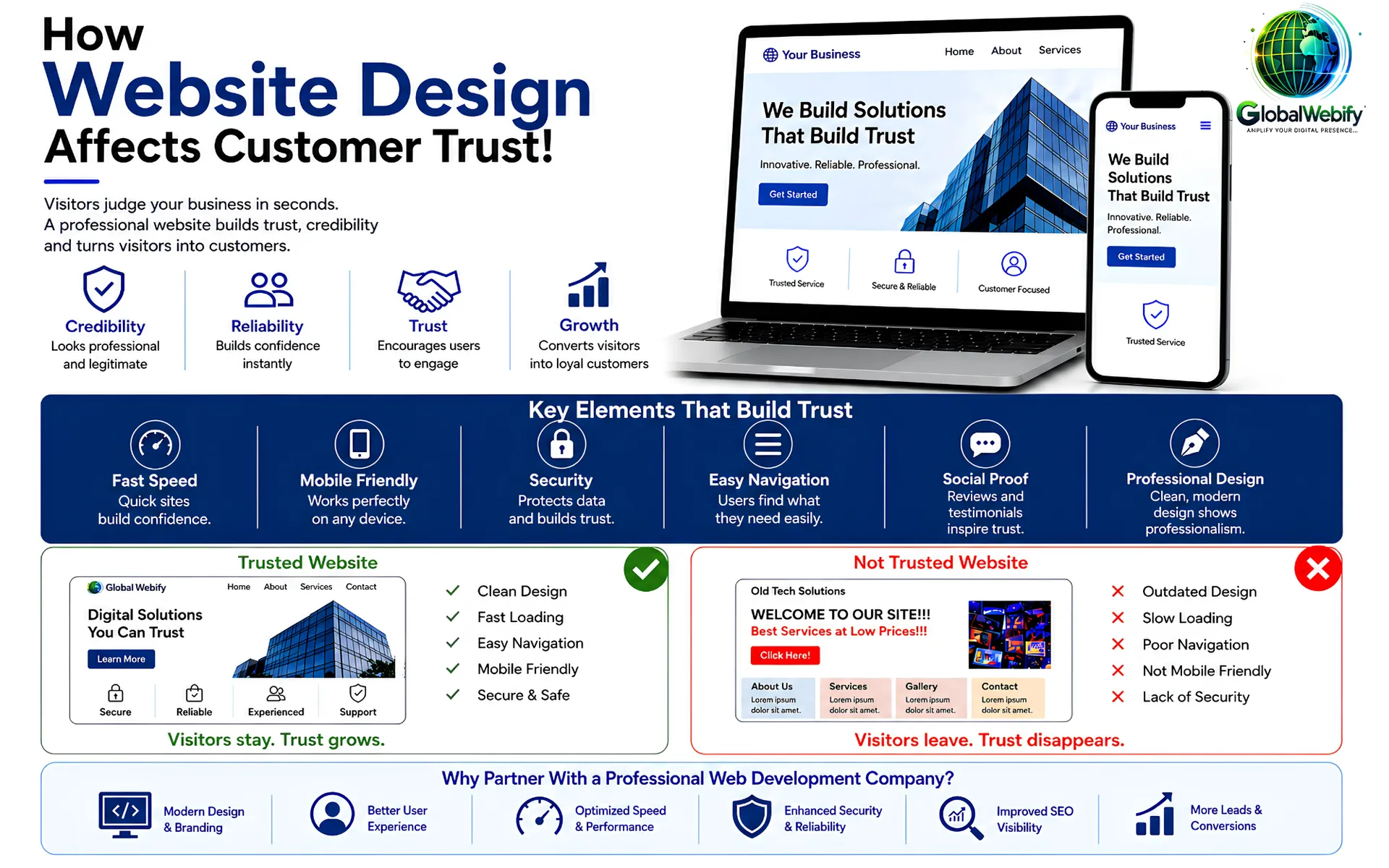
How website design affects customer trust!
For businesses investment in high quality Website Designing Company is ultimately an investment in customer trust, strong relationships and long-term business growth.
Think of Website as a first handshake between potential customer and business. Within a few seconds of landing on a website, visitors begin forming opinions about a company. Website denotes the professionalism, credibility and reliability and reliability. Customers today decides whether the business appears trustworthy before reading about products, comparing prices, or contacting a sales representative. Studies show that website visitors form opinions about a business almost immediately after arriving on its homepage.
Trust is rarely built overnight, yet it can begin-or disappear-in a matter of seconds. For modern businesses, website design is no longer simply about aesthetics. It has become a critical factor in establishing credibility, creating positive impressions and converting visitors into loyal customers.
For example, there are two businesses offering the same and identical services. The first present a sleek, fast, mobile friendly website that has clear messaging and professional branding. The second one displays and updated website with broken links, slow loading pages and cluttered layouts.
Consumers will instinctively trust first business as compared to second business even if they had no idea about either of the company. This shows a fundamental truth of modern-day commerce: website design directly influences customer trust.
This is the reason why businesses increasingly partner with web designing companies or an experienced digital marketing companies that inspire confidence and encourage engagement.
The psychology of first impressions
Rapid judgement is like a second nature to human beings. Research in consumer psychology consistently shows that perceptions of competence, reliability and professionalism is influenced by the visual impressions.
When visitors land on a website, they ask several questions -
Does this business look legitimate?
Is this company trustful?
Is the company professional?
Do they appear established and credible?
The design of the website, answers all these questions before any conversation takes place. Balanced spacing, clean layouts, high quality imagery, fast loading pages and consistent branding communicate professionalism while poor design creates uncertainty and distrust among the customer.
For example, A firm name Global Webify, whose website features up-to-date graphics, consistent fonts and navigation while on the other hand if a firm has outdated graphics, inconsistent fonts and confusing navigation, even if the firm employs highly qualified experts, many potential clients may hesitate to contact the second firm because the website fails to convey competence.
Professional design reflects professional service
It is assumed by the customer that the quality of the website reflects the quality of the company’s products or services. A polished digital presence signals that the business invests in excellence and phase attention to detail.
Reputable web development companies understand the effectiveness of website designing and does not treat it as merely aesthetic. It is about creating and experience that feels trust were the intuitive and reassuring.
Elements that contribute to professional credibility include -
Consistent branding
Modern typography
Clear calls to action
Logical content structure
Readable formatting
Professional colour schemes
When these elements work together visitors perceive the business as reliable organised and competent.
That's why business searching for website developer near them often prioritize developer with expertise in design that is responsive. Or responsive websites automatically adapt to different screen sizes and ensure a seamless experience across all devices. Mobile responsiveness communicates that a business is modern, customer focused and attentive to user needs.
Websites speed as a trust signal
One of the most influential factors to build digital trust is speed. It is expected of websites to load almost instantly. Delays create frustration and doubts about the company’s professionalism and legibility.
A slow website can suggest -
Potential security concerns
Outdated technology
Poor maintenance
Lack of investment
While a fast website creates a trust between consumers and the service provider.
An experience website development company like Global Webify optimizes performance through efficient coding, caching, image compression and modern development practices.
Navigation and user experience
Trust grows when users can easily find the information they need. Confusing menus, hidden contact details and poorly organised pages create confusion and frustration for the customers. It is the reason for trust issues. For example, if a person visits a hospital website to book an appointment, but the appointment form, phone number, or service information are difficult to locate, the confidence in the institution may decline and the person might try to investigate other potential service providers or hospitals.
Effective navigation includes -
Search functionality
Clear page labels
Visible contact information
Simple menu structures
Logical content hierarchy
A professional web designing company prioritizes usability because an intuitive website makes user feel in control.
Role of security in building trust:
Cyber threats are common and consumers are increasingly careful about sharing their personal information online. Security features are no longer optional they are mandatory and essential trust signals.
Essential trust building security features-
Https encryption
SSL certificates
Secure payment gateways
Data protection measures
Privacy policies
Regular security updates
Users observe security indicators and professional privacy practices and are more likely to complete purchases, submit forms and engage with the business.
Social proof and credibility
People trust other people and their word of mouth. Word of mouth is considered as one of the best marketing methods. Reviews, testimonials and case studies reduce uncertainty and provide proof that the business is delivering results.
For example, when booking a hotel most travellers see reviews, photos, testimonials etc before making a reservation. Positive feedback from previous customers makes them feel confident about the business and their decision.
Business can strengthen trust by displaying:
Customer testimonial
Google reviews
Client logos
Awards and recognitions
Industry certification
These are the elements which provide reassurance that real customers have had positive experiences with the company.
Consistent branding create familiarity
Trust is mostly built through repeated and consistent exposure. Businesses must maintain the same visual identity across its social media platforms, websites, advertisements and marketing materials to be recognised by the customers. It creates a brand identity.
Consistent branding includes:
Logo usage
Visual style
Messaging tone
Colour palettes
Typography
Brand identity makes a business appear organised established and dependable.
Content quality and perceived expertise
We must keep in mind, that attention is grabbed by the design but content builds authority. Visitors evaluate whether a company understand its sector and industry and can provide valuable solutions.
High quality content may include:
Industry insights
Educational blog post
Frequently asked questions
Guide and resources
Detail service page
For example, a cyber security company that publishes informative articles about data protection will generally appear more trusted than one with outdated or minimal content.
A strong combination of professional design and valuable content, positions a business as an expert in its field.
Transparency and long-term trust
Easy and open communication is appreciated by customer. Honest service descriptions, accessible contact information, clear pricing and detailed profiles help reduce uncertainty among customers. Transparency signals confidence. Businesses that clearly explain what they offer and how they operate are often considered more trustworthy than those that lack important information and show vague marketing languages.
Why business to professional development partners?
Creating a trustworthy website requires expertise in design, user experience, performance optimisation, security, branding and conversion strategy. This is the reason why many organisations want to work with a specialized Web development company rather than relying on basic templates or outdated solutions.
A professional development partner can help businesses to create a modern visual identity and improve user experience. It enhances security and optimise websites speed, also increases search engine visibility that helps to generate more leads and conversion.
How Global Webify helps businesses build trust online!
In today's competitive digital landscape, business is in need of websites that does not only look attractive but also inspire confidence and drive results.
Global Webify focuses on creating responsive, performance driven and professional websites that help businesses establish credibility online. Global Webify combines modern designing principles, intuitive navigation, mobile responsiveness, strong security practices and user focused experiences. Global Webify also helps companies to build strong relationship with their customer and enhance their digital reputation.
Conclusion
One of the most valuable assets any business can possess is customer trust, and website design plays the decisive role in earning that trust. From first impressions to mobile responsiveness, speed, security navigation and content quality every aspect of a website influences how visitor perceive a brand.
Customer search for reliability competence and attention to detail in any website. In contrast, an outdated or poorly managed websites can undermine credibility before a customer can even make contact.
For businesses investment in high quality Website Designing Company is ultimately an investment in customer trust, strong relationships and long-term business growth.