





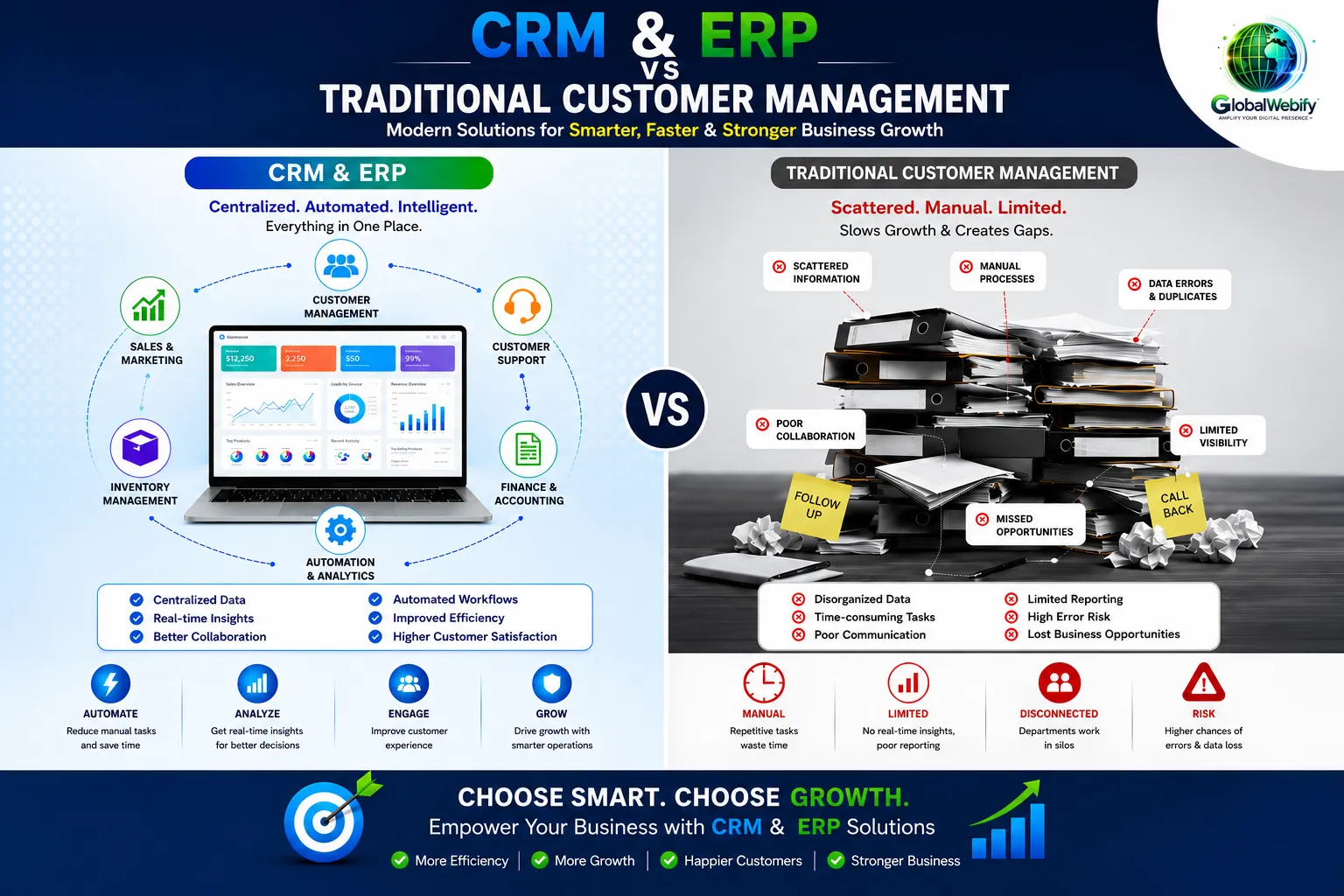
CRM & ERP vs Traditional Customer Management
This blog will explore the difference between CRM or ERP and traditional customer management while highlighting why distil solutions have become an important part of business in 2026 and beyond.
What can be the most valuable asset for the business, it is customer relationship. In today’s world fast-paced business environment, managing customer relationship and data effectively and efficiently for growth and long- term success.
Advanced technology is now being adopted by modern businesses such as CRM software and your peace systems to improve customer service, reliability streamline operations and increase profitability. It is a centralised approach to manage customers sales inventory finances and business processes. This blog will explore the difference between CRM or ERP and traditional customer management while highlighting why distil solutions have become an important part of business in 2026 and beyond.
Understanding traditional customer management
Traditional customer management comprised storing customer information manually through spreadsheets, emails, physical files, notebooks, diaries, Excel, word files etc. Customer interactions sales records and follow up activities where often trapped by individual employees rather than thrower system which is centralise and easy to extract data.
This method although may seem easier it creates several hurdles.
Customer information is scattered across multiple locations.
Data can be easily lost or easily manipulated or duplicated.
Followers depend heavily on employee’s data gathered as per their advantage and convenience.
Reporting and analysis become difficult.
Communication between departments is constricted and limited.
Business growth becomes harder to manage as there is no relevant, easy extractable data.
As customer databases expand, traditional practices become more time-consuming and prone to errors and glitches.
What is CRM
Customer relationship management software is a technology solution designed to help small and large businesses to manage customer interactions marketing companies’ customer support sales activities from a single platform.
It focuses mainly and primarily on improving relationship with customers by tracking and organising every interaction with prospers and existing customers.
Key features of CRM include
Marketing integration
Sales pipeline tracking
Contact management
Customer communication history
Task automation Analytics
Reporting customer support management
CRM enables businesses so that they can understand the customer behaviour and provide a personalised experience which eventually increases loyalty and satisfaction in customers for the business.
What is ERP?
ERP stand for enterprise resource planning. It is a business management system that integrates various departments and processes into a single platform.
ERP manages internal operations which primarily focus on
Human resource
Inventory management
Procurement
Supply chain operations
Finance and accounting
Manufacturing processes
Project management
It enables businesses a complete visibility into their operations which ultimately improves efficiency and decision making.
CRM and ERP versus traditional customer management
1. Centralised information
Traditional customer management stores all the data in different spreadsheets, emails, in the form of documents or Excel sheets etc.
With CRM and ERP system, all the information is stored in a centralized format. Employees can quickly excess data of any customer, records transaction history, invoices, communication logs, inventory data from one particular location etc.
They don't have to ask other colleagues and employees for the data.
For e.g. If a company wants their sales and leads data to be centralized. They need a CRM for managing their leads.
Why will anyone need software?
Traditional systems which often required manual record and tracking of the which eventually increased the risk of missed opportunities.
For example: Modern software automatically captures every data related to sales and leads from websites, contact form, social media and different marketing campaigns. Sales team can monitor lead progress and follow up efficiently and it can also be accessible to other colleagues and seniors or team leaders for easy tracking of data.
CRM software will ensure that every lead is properly nurtured throughout the sales journey.
2. Automation
Traditional customer management involves repetitive and administrative task such as reminders, follow ups, report generation, data entry etc.
CRM in ERP systems automate these processes reducing human error and glitches and improves productivity.
Automation also allows employees to focus on customer engagement business growth and sales rather than administrative work.
3. Reporting and analytics
Traditional methods offer limited capabilities for reporting and often require manual data compilation. Whereas CRM and ERP provide real time dashboards and detailed oriented reports that help business monitor:
Inventory levels
Sales performance
Revenue trends
Employee productivity
Customer engagement
Operational efficiency
Strategic decision making is all based on accurate data and CRM, ERP provides easy access to it.
4. Team collaboration
In traditional environment, communication gaps often happen because departments work independently. CRM & ERP system allows different departments and teams to share the data efficiently and seamlessly. Finance, marketing, customer service, operations teams can collaborate using the same data source.
This improves effectiveness and efficiency and create a better experience for both the customer and the vendor.
Benefits of customer relationship management software
Improves customer experienceCustomer always expect quick responses and personalised reactions and interactions. CRM stores customers data, communication history and records of sales-purchase allowing business to provide tailored services.
Better sales recordCRM platform helps teams prioritize opportunities and focus on qualified projects.
Enhanced customer retentionRetaining customer is cost effective and acquiring new one is truly A painful process. CRM software enables businesses to maintain strong customer relationship through regular communication and proactive support.
Increase productivityAutomated workflows eliminate task that are repetitive and also administrative burden is reduced, helping employees work more efficiently.
Benefits of ERP systems
Streamlined operations: ERP software integrates business processes across departments which reduces duplication and improves work flow efficiency.
Scalability: As business grow ERP systems accommodate with increasing operational complexity without sacrificing its effectiveness and efficiency.
Improved inventory control: Organisations can track inventory, purchase orders and stock movement accurately, which reduces shortages and over stocking.
Better financial management: Systems provide real time financial data which helps business monitor expenses, profitability and cash flow.
Why business need both CRM and ERP?
Many organisations often believe that they must choose between CRM and ERP but in reality, the two systems complement each other.
CRM manages customer-facing activities while ERP handles internal business operations.
When integrated, CRM and ERP provide a complete view of business performance by connecting
Inventory data
Sales activities
Financial records
Customer information
Operational work flows
Service request etc
This integration improves the decision making of the company and also enhances customer satisfaction which ultimately profits the firm.
The role of website integration
It is often seen that the first point of contact between a company and potential customer is a website. Integrating websites with CRM and ERP systems ensures that data of the customer flow seamlessly into business processes.
By working with an experienced web development company, organisation can create a fully-digital ecosystem supporting business growth.
Choosing the right technology partner
Implementing CRM and ERP solutions required technical expertise.
A company should always go for the trusted website development companies which can help businesses select, implement and customise the right system based on their requirements.
Likewise, an experienced web development company can also ensure seamless integration between websites, CRM platform, ERP system and other business applications.
A company should always priorities Website Development Companies with experience, technical knowledge, and proven success in CRM and ERP implementation projects that has been delivered.
Conclusion
Limitations of traditional customer management have become evident as businesses face growing customer expectations and operation complexity. Manual methods may work for small organisations with limited number of employees and clients but they cannot provide the efficiency scalability and insight needed in today's competitive digital marketplace.
CRM software helps businesses to manage interaction with customer, improvement in sales & enhances customer satisfaction whereas ERP regulates internal operations, improves resource management ultimately supporting organisational growth.
CRM and ERP create a complete business management solution that drives productivity profitability and customer success.
When partnered with a reliable, experienced and trusted company business can successfully implement these technologies and build a strong foundation for future growth.